10 Dec 2007

Ragging !!! Why are we so obsessed with it???


A: "I got through Class XII Board!!! I am going to college!!! Oh boy, oh boy, oh boy!!!"
B: "But aren't you afraid?" "You know the seniors are really rough." "The ragging and all ..."
A. "Oh ya. I didn't think about it" "Its good you told me." "I will ask big bro if he has a friend at my college who could help."

Welcome to a typical Indian college-starting one's psyche and visions about college. Each year so many pass schools and move to college, only to find a rigged-world, even violent at times, not so friendly, and absurd really. "How does all this help me in making a better individual, if college life is meant to be that???" and other similar questions floating in the sky for these young-college-goers.

But then its the same every year. New platoons coming in and old ones trying to establish their dominance. I saw 'Jar head' the other day and found that this was even in Army. That may even be tolerable with Army people the so-called tough guys. But those who barely know what is ego-clash, dominance, fight-club et. al., being always in a small-compact school, ragging them is really being tough (if not brutal) on them.

The Supreme Court says the institution will be liable if they don't stop that, there is an expert (Raghvan) Committee Report on the subject matter and repeated references to the guidelines but no, the things do not fall in place. The things go on as ever; if not overtly than covertly.

But why are we so obsessed with it? Why do the seniors feel happy to have meted out their juniors with brutality and misdemeanor (ofcourse you would have made out by now that I am not against a healthy introduction and all, but yes when things start to get violent and against the notions of dignity, that is where I say one has to say 'stop')? Why? Why? and Why?

Is it reciprocity? One of my friends had put it that its because we got that, so we are giving that back. I keeps on flowing like from generation-to-generation. But then I ask, is it something worth handing down? It is on the same footing as one from a father to a son? I don't think so and think that no reasonable minded person would agree to that. Then why? why do we keep this practice intact, as if it is a heritage.

I understand that law-enforcement is really a problem and having a law against something does not translate automatically as meaning that end of problem (ya, the evidence on the effectiveness of child-marriage prohibition laws, anti-dowry laws, anti-sati laws, etc. all same thats) but that doesn't mean we do not take an occasion to look in our souls and ask "are we doing the right thing? "is it something I will want my child to face? "do i really resound as being a dominant personality when I rag someone?" et. al, which make you realize the worth and effect of the things we happily indulge ourselves in.

The answer will definitely be "no", I am sure of that. But if it is "no", what do we do to translate that "no" into action. Thats a big question and there is a lot of soul searching to be done. But surely and certainly, its not a good practice that we carry or take for granted.

Life without a top-up ...


For the last five years the cell which I carried was post-paid, with the bill being sent home. [sounds good na???] But then I landed in London, had to get a set for myself, got a 'pay-as-you-go' connection, [its really funny that this term is used for anything and everything; oyster; bus; and even income tax]. Too happy that the 10 pound credit lasts more than a month, I was calling one-and-all and then suddenly I am left with "this number is barred from your phone." I am like wtf???

I am in the middle of no-where with a meeting planned with my friend to meet there. How do I tell him I am coming or not coming? Well thank God that he himself called and I could tell him where I was (and to keep him telling the directions when he is still holding up and we finally meet after 15 minutes, he still connected by them).

You are taking a bath when parents call you from home. You can't call back because your 'low-balance-recharge-please' phone does not allow you to and you are really embarrassed asking you mates to borrow their phone because its an international call and its 'peak-time'.

Your class-mate gives you a missed-call (which she is used to) to you to inform after a preponed class, which ofcourse which I find out later, but since you are 'low-balance-recharge-please', you miss it, having lunch and showing up at the old time, finding out that the class has already taken place.

You try to send sms to your friend (who is not so online-types) to tell him that you can't call and then, 'low-balance-recharge-please' doesn't allow you as well. You receive a letter for interview and are asked to confirm whether you will be able to make it at the time, but your 'low-balance-recharge-please' tells you that you got to borrow a phone to call them up. And you start to identify someone who wouldn't mind lending the phone and you find the would is a huge mess of ignorant and selfish people, who are also 'low-balance-recharge-please'.

Then I got a Carphone-Warehouse to get my 'low-balance-recharge-please' topped up, because the online thing would not recognise my Debit card which is apparently a 16-digit-number-card where the space is only for a 12-digit-number-card.

And so I get a top-up and get a 10 pound credit again. Rejoice. Hurray. But what next? Should I send an sms to all that I can call them now??? Sounds silly? Plus waste of credit, unless I want to hear 'low-balance-recharge-please' again.

Oh what a mess... These cells and top-ups. But guess life won't be the same without them. So I call my pals and home. Waiting for another 'low-balance-recharge-please' ...

9 Dec 2007

Delhi court settles 100 cases in two days !!!

I was delighted to read this post in rediff that a trial judge went a long way to play her part in reducing the back-long of the cases, which has really been a stigma on the Indian judicial system.

"Additional District and Sessions Judge Kamini Lau did not mind spending extra hours to finish the cases, pertaining to theft of electricity, claims with various power companies and malfunctioning of the infrastructure", reports Rediff.

Not long back, I had the occasion to write about the pitfalls of delay in judicial redressal, but then it seemed like an issue taken for granted. The monthly report of pending cases in the Supreme Court does not inspire confidence either.

Every once in a blue moon we hear that a judge went out of the way to dispose more cases than the national average. But the point is, are their any incentives for the judges who really take toil to clear the backlog? Is there any mechanism in place to ensure that this takes place at a regular basis, till the time the pendecy is within acceptable limits?

No answer clearly seems to be forthcoming. Blame is transferred by ailing huge vacancies in the judicial lines, lack of proper infrastructure etc. But shifting of this blame game is not for the county as a whole and certainly for the people as well.

Why IAEA is such a huge issue in India?


Once there was a time when Mumbai used to come to standstill at the roar of the tiger, Bal Thackeray. But things have not remained the same. A few days back (or even a fortnight), Mumbai halted because of El Baradei. Does that name ring any bells? Or who is he?

Well, he is the chief of the dreaded-word IAEA, which has been amidst the centre point of the ongoing controversy and drama in the Indian parliament. The Left conceptualizes him and the organisation he represents as a harbinger, resounding clutches on India's progress. Why? Because he and his organisation is at the centre point of the Nuclear Deal which India has signed with the United States. [click here for full list of events.]

Still no clues??? Alright, I will disclose now who he is. He is the Director General of the International Atomic Energy Agency, the UN's nuclear watchdog. And the reason why his organisation is dreaded because of the Nuclear deal whereunder India agreed to allow IAEA to supervise its nuclear plants, therefore technically amounting to an external control over hitherto India's foreign-influence-free nuclear policy. This is the biggest reasons for the Left's hue and cry over the issue; that India's freedom has been restricted under the Nuclear deal and its opposition to IAEA.

But is the issue really that big to rock Indian Parliament for more than a quarter-year now???(since August 03, remember ???) What would be the consequences if the events do lead out to an IAEA supervision on Indian nuclear reactors???

Well, under the terms of the Nuclear deal, India is obliged to use the nuclear materials etc. supplied by US only for non-military purposes (which indirectly means a ban on conducting further tests on nuclear bombs etc.) and in the event India does decide to go with the military uses, the deal would be suspended. But who decides whether India has in fact used the material for non-military purposes. Well, if the IAEA deal goes through, IAEA would be the sole determinant of this.

This would mean that if IAEA says so, India has used the nuclear material for non-military purposes even if it hasn't. The position of IAEA is singular. It reports as a special agency of the United Nations and submits reports, which are acted upon pretty quickly. (Heard about its report on Iran and the later turn of events with the US even threatening about going ahead with an exercise similar to Iraq???)

Then, further, India will be obliged to grant full access and know-how to IAEA officials of its nuclear programme, something out of the ordinary for the Indian nuclear policy. In order to fulfil its mandate, IAEA may even be required to examine the Indian civilian nuclear power plants and so goes off our vision for energy security, the Left and others cry.

So we know what are the costs of this. And proposed benefits??? Well unless India goes on to allow IAEA to have a seat and inspection rights to its neclear ractors, the Indo-US nuclear deal will not go through. Unless the deal goes through, India will not get uranium and other nuclear-energy assistance required to go ahead with its energy programme. The entire load, therefore, will be on our indigenious energy resources (i.e. coal majorly and to some extent hydro-power), which definitely are not capable enough to meet our present energy needs, forget even contemplating about our future needs.

So what do we do? Say yes to IAEA and allow our energy requirements to be met with a contingency of foreign/external control over our works or say No and goodbye to IAEA and strive without energy to maintain a growth-rate of 8-9 percent. The answer is for you to decide. But do let me know your views on this.

Ice cream in Taxation !!!


Well, this is really a funny one. Was just reading a book on taxation of derivative contracts. There I came to know that there exists an ice-cream flavour developed by financial markets and taken care of by law. Heard of 'plain vanilla'??? No??? Well same was by case when I heard about it for first time; "come on, you gotta be kidding" types.

But naah, they do exist. This term is in fact very popular in financial markets, used to describe a simple financial instrument (no wonder 'vanilla').

Keep looking and tell me if you find more of ice-cream in taxation. [ :) ]

8 Dec 2007

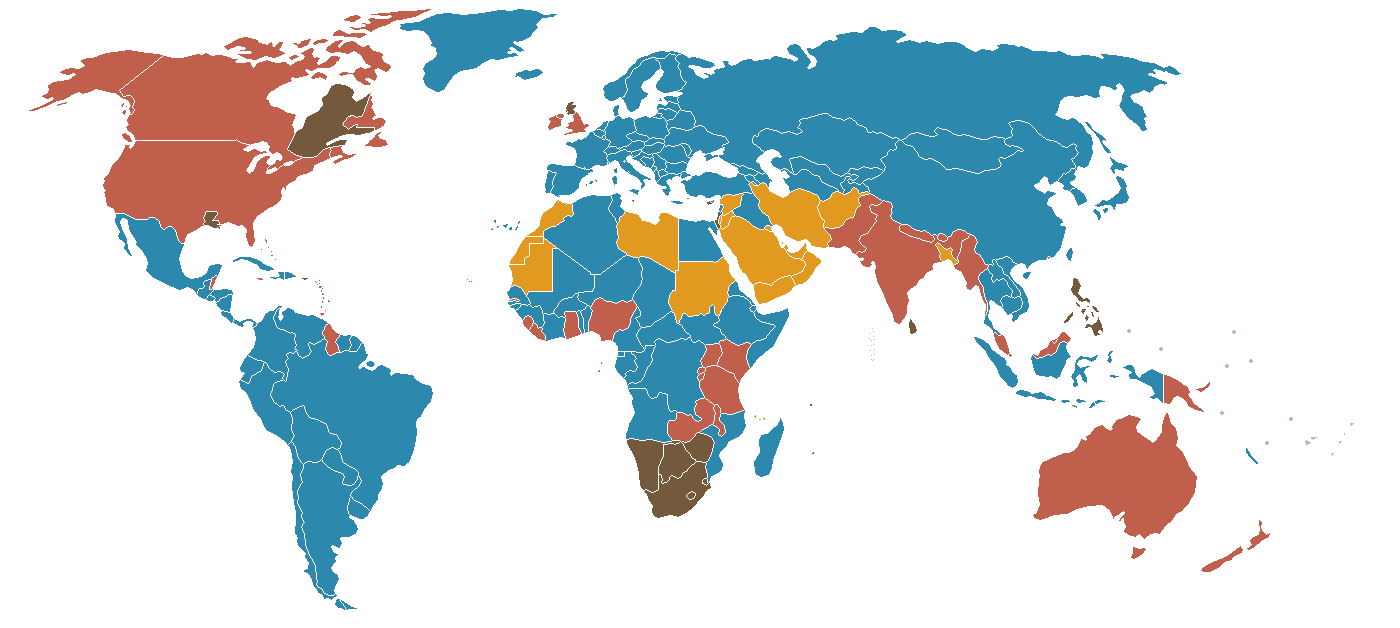
Major legal systems of the world (Law Series - 3)


(Thanks wiki for such a well-researched diagram)
(click to enlarge)

I hope you have seen the movie 'Welcome to the jungle'. [If not, perhaps this trailer might help. See the part after 1.45 minutes]. It gives an amazing description of the rules that govern humans inhabiting the rain-forests. Not exactly, but yes, a fair description of tribal culture, where might is right and you got to have it in you, in order to survive. In early times, law used to be like that. It used to be governed by the ablest man's sword and whatever he said was the law. Thats the first legal system. Tribal laws. You might wonder whether it survives the scrutiny of modern times and advanced civilizations, but it still holds good. Be it Amazon's rain-forests or Andaman's tribal communities, these notions still continue. Perhaps an anthropologist might add more to that list.]

It is often said, common sense is not so common (so much so that I have even seen a book with that title, and ya, not read it). But such uncommon common sense is the common law. Confused? I will give you more reasons to be.

Ever met a reasonable man? Or a person whom you can call a perfect one ? [Hey, stop. I don't mean one perfect for a spouse] Perfect in the sense, one who would commit no mistakes, (not one who commits but is pardonable), one whose decision is perfect (not just for you but for all), one who knows everything and is wise, one who is strong but only to the extent an average man should be strong, one who is feeble but only to the extent an average man is feeble, one who is governed by human values but is not emotional, one who is smart but not smarter than an average man? Think you are really confused now by what I mean. But perhaps this is what I want.

I can quiet guess that your answer to the above is 'no'. Some might even to the extent of saying that there is no man on earth which fits the description. I quiet sympathize but sadly enough, there is one legal system on this planet which does not agree with you. It believes that such a man exists and exists in a big way. Such a big way that it is there at all times and at all places, one known as 'reasonable man'. This Mr. Reasonable has such a profound influence on this legal system that the entire system revolves around this Mr. Reasonable.

What would Mr. Reasonable do in this situation, what should have been the natural response of Mr. Reasonable, why should she/he not act like Mr. Reasonable in the situation? Does this sound familiar? Welcome to the 'common law system'. A system which believes the reasonable man is very common (and not so uncommon as per our understanding) and applies this test for all circumstances. All actions and inactions are judged from this reasonable man test to determine their compatibility with the law. This system is developed on the decision of the judges, which is known as 'common law'. The belief was that the judge had some divine connection with the Almighty that enabled him to lay down a rule (technically called 'precedent') which would be fit and apt for regulating human behaviour for all times to come, unless another divine logic comes to override the previous one. Now this has largely been taken over by legislature, which lays down the law and judge enunciates it. However, the judges continue to exercise this rule-laying down power and fill the gaps which the legislative law carries. Therefore, common law.

There is more to this though. The systems starts with law and then applies life-situations to it i.e. first comes the law and then whether the party to an incident acted in a manner consistent with the law laid down. This is the major reason which this system is stuffed with legal jargon, technical concepts (you already know one by now; the reasonable man, remember) and gives tremendous important and thrust to legal and logical reasoning (thought its really amazing that they do not collide most of the times) in solving life problems. [England, United States, India, Canada, Australia etc. are prominent countries following this common-law system.]

As opposed to this heavily-law biased system is another system where the factual aspects of the matter are more relevant rather than the technical enunciation of law; the 'civil law system'. It is easy to understand it as it is quiet the opposite of the civil law system. It starts with facts and then moulds the law to arrive at the correct decision. Here judge is not one wise man entrusted with a solemn duty to lay down a norm for social behaviour like in the common law system, but is in fact meant to resolve the dispute, termed as the 'inquisitorial' method of dispute resolution. The law here is a code, existing in advance and the judge is to resolve the dispute in accordance with the code. This is quiet distinct from the common law, where the judge generally adds to the existing body of law. [France, Germany, Denmark, Norway are some countries which follow this civil-law system]

Having read through the technical aspects and nuances of the these two major legal systems (I am sure you would be jittery and feeling heavy by now), I now take you to a simple and easily understood system. A legal system is dictated by religion and administered by religious priests. No wonder it is called 'Religious-law system' (though sometimes also termed as the 'Ecclesiastical System'. So what the religious texts, as interpreted by the clergy, say is the law that governs the people. Simple really, right? [Afghanistan, Iran, Saudi Arabia, Sudan are some countries which have adopted this legal system]

Then there remains just one more system to be understood; the 'customary system'. Though technically not a system in itself and just a principle of law (i.e. law develops from custom) it tends to be a system where habits and mannerisms of people force them to apply it as an obligation for all. This system is virtually a non-starter and not very prominent. Yet, wikipedia identifies atleast one country following this system.

Lastly, but not the least, don't be surprised to find a country the legal system which bears resemblance to more than one above. This is for the reason that countries keep experiencing and the judges tend to import concepts from other legal systems into their own. So we have various systems which reflect a culmination of the above principles. But in essence, they do tend to follow one system predominantly than the other.

Hope this was one interesting than the previous one (as I was told to do).

7 Dec 2007

Science as Intellectual Property (Book Review)

Dorothy Nelkin, Science as Intellectual Property: Who Controls Research?, AAAS Series on Issues in Science and Technology, Macmillan Publishing Company, New York, 1984 [pp. i-ix, 1-130]

This book by Ms. Nelkin, published under the aegis of the 'American Association for the Advancement of Science' is one thought-provocative and eye-opener account of a late sociologist of science which makes interesting observations on the changing directions of scientific research, primarily owing to the increasing governmental interventions and commercial motivations plaguing the hitherto objectively-driven field. In the seven chapters of the Book, she has sought to address various intriguing questions relating to the increasingly being monopolized scientific research; some of them being, who controls research; who determines the flow of scientific knowhow; etc.

Chapter 1 titled 'The Ownership and Control of Scientific Information' raises several questions to begin with; what does government funding mean in terms of public access and investigator control?; does the Freedom of Information Act apply to research that is in progress?; can scientists themselves use their data and ideas in whatever way they choose? etc., which are indeed perplexing and for which there exist several unlinked and diagrammatically opposite solutions. Distinguishing between 'basic research' (one 'concerned primarily with the advancement of knowledge') and 'applied research' (one 'oriented towards the development of new products of commercial or military value') she raises genuine concerns as regards the directions towards which "the research" is heading to. Adding various illustrations (I would just point out one which I think is a routine-matter these days), she brings to fore the concerns affecting research trends; "Questions of ownership and control arise when scientists attempt to disseminate health and safety data in what they believe to be the public's interest and are blocked by agencies or employers seeking to control the research they support."

Chapter 2 titled 'Proprietary Secrets versus Open Communication in Science' starts with an interesting real-life dispute on the ownership of research results on a blood-sample of a leukemia-affected deceased; a tussle between a not-for-profit research group of a University and a pharmaceutical giant. She hints the profit-maximization tendency of corporations as restricting research to those areas which promote commercial gains rather than development of scientific temper and adding to the existing knowledge base of human-kind. She adds a series of other real-life situations which leaves the reader bewildered as to the extent and consistency with which biased and purely-profit-driven inducements have been plaguing the field of scientific research. The approach of the law courts in this regard is also made a subject of critical scrutiny in the Chapter.

Chapter 3 titled 'Public Access Versus Professional Control' brings to fore empirical evidence to the end that even the 'Freedom of Information' enactment has been abused by the failure of the authorities to disclose and grant access to controversial information, which may have been prejudicial to certain political or commercial groups with the net effect being; outcomes of research being given a back-burner treatment. Thus she illustrates that even the ways of means for the public to access information and outcomes of the scientific research has been controlled, if not blocked, by professional agencies with not-so-clean intentions.

Chapter 4 titled 'Rights of Access versus Obligations of Confidentiality' begins with an interesting account of the (1971) circumstances surrounding political scientist Samuel Popkin in relation to his 'research on political forces and social movements in Vietnam and on the American policy in that country' wherein Popkin had to face imprisonment for contempt for
inter alia his refusal to disclose the information he had collected during his research, followed by the refusal of the Supreme Court to interfere in the matter. She further goes on to give other accounts wherein researchers have been manipulated or man-handled in the wake of vested interests and their confidentiality rights being breached; another method of influencing scientific research.

Chapter 5 titled 'Whistleblowing Versus Proprietary Rights' is replete with illustrations wherein researchers, who have come to know of abusive practices prevalent in the organizations they were associated to and have tried to expose the same, or have not worked in the sponsored line of the organizational policy, have been shown the way out. She then goes to empirically establish the widespread discouragement to disclosure of prejudicial information, despite the same being scientifically relevant. Another lesson for researchers to act in the line shown and not digress!!!

Chapter 6 titled 'National Security versus Scientific Freedom' is a catalogue of events and incidents wherein scientific reports has been gagged in the name of national security concerns; yet another reason to identify the manner in which scientific research is redirected to selected lines and shunned from restricted areas.

Chapter 7 titled 'Negotiating the Control of Scientific Information', though the final chapter of the book, really puts the final nail in the coffin. She personifies the relationship between science and society as a marriage, a relationship implying 'shared assumptions and mutual trust', which has been breached and modified as a 'negotiated agreement and exchange'. Clearly, she has dealienated the level of intervention which the development of scientific temper faces. Building up the relevance and importance of 'science in a changing society and political context', 'science, sovereignty and secrecy', she concludes, if at all it can be described as conclusion, that the future of independent scientific research may as well be hidden in 'negotiation and accommodation' wherein even though there may be apparently not 'moral justification for limiting the freedom', but the course may as well take such limitations for granted and proceed thereon, acknowledging them as the obstacles but nonetheless moving ahead in its quest for an independent co-existence with other natural and allied sciences.

A worthwhile reading. [ :) ]

Why LAW? (Law Series - 2)


Situation 1: Mr. Giant approaches Mr. Cute and says 'hey dumbo, I don't like your face!!! I am going to reshape.' Gives a punch and blow on the eye. Laughs and leaves. Mr. Cute is left ailing.

Situation 2: Miss Yojyna plans to goes for shopping at Oxford Street. She takes a cab from Regent Street and asks the driver to drop her at the nearest bus stop. The driver says 'Madam, why are you taking the cab. Oxford Street is just around the corner, just walk.' But she insists. So he says, 'alright. I am gonna take you to Oxford Street but you have to pay double the charge of whatever comes on the machine.' She responds, 'alright. so be it'. The driver drops her at the bus stop and asks for double the amount, as promised by her. She replies 'you cheat, you liar, you thug!!! you harressed me and tempted me to get in your car so that you could sell me to a sex-shop. help, people help !!!' The cab driver sees people accumulating and so runs off.

Do these situations make you think? Is there something unfair going on in here? Is everything ok? Are the people crazy? Or is it just an everyday affair? Happens just around the corner everyday, right?

I will try to explore the answers to these while dealing with the issue, why law?

Though the question 'why law' is not as perplexing a question as to 'what is law' but the answer to this is essentially embedded in the determination of that other question. Thus the most approximate answer to this 'why' is that law is needed to regulate human behaviour. But another 'why' leads to the question, 'why do we need to regulate human behaviour?' and it is here that we need to appreciate the nuances of a social structure, that also leads us towards discovering the answer to the question 'why law'.

Defining human behaviour is, essentially, a prediction as to interactions which take place when two humans interact; do they act friendly, do they turn hostile, do they act as unknown, etc. The reason is essentially the xenophobic and self-preserving tendencies of humans, coupled with the fear-factor and self-interest motivations, which influence interactions. Therefore, there arises a need for an independent unbiased person/institution to define the specific parameter in which the interactions should take place. These parameters acts as the rules of bounded rationality in which the interactions should take place.

The rules (or 'law') conceive general and specific situations which are to be promoted or avoided and accordingly devise mechanisms influencing these interactions. To illustrate, the rules prohibit interactions between parties where there is an inequality of bargaining power (therefore the concept of undue influence and other 'vires vitiating consent' in the law of contracts). Also, the law gives a legal protection to those entities which are considered to be ignorant of their self interests (like doli incapax and similarly the concept of statutory rape in relation to minors, etc.). It is here relevant to point out that these rules vary across countries and regions, depending upon the social ethos and morality issues operating therein. For example, while India prescribes laws against the harmful practices of Sati and child-marriage, there may not be any need for these laws in European jurisdictions wherein such practices are unknown.

As regards the side of promotional factors, one illustration can be the promotion of research and development, intellectual outputs etc.; therefore the protection and right of exclusive exploitation to the harbingers of intellectual property. Similarly, the law rewards good behaviour and so the concept of probation.

Therefore law comes to define the environment in which the interaction should take place; the manner in which interaction should take place; the grounds for and effects of abuse; prohibitions and debarring of erring individuals; rewards for good behaviour; etc. Thus law is required to govern; govern the governed (individual or subjects) and govern the governing (person or institution). Thus these set of rules act as the paramount basis for governance, and this is how the legal system works. And therefore we have LAW.

Now let us come back to our two situations. It may be right in a few places that Mr. Cute was punched. But a majority of people will say that this was wrong on the part of Mr. Giant and he must be punished for that. But why should he be punished. Did he do anything wrong? Not until it is recognized that the conduct of Mr. Giant was unacceptable in a social system and there is a punishment prescribed for that. Doing that, is precisely what law is for. It recognizes and defines what is impermissible social behaviour and proscribes mechanism to ensure that such incident is not repeated.

Similarly, in the second situation, while it was wrong on the part of the cab-driver to ask double payment, it was similarly wrong on the part of Miss Yogjna to shout at him in an offensive and rude manner. Now it depends upon the social perspective in which we are in, to decide what law should prescribe for it. Should the driver be held to have done an acceptable act (and thus there be a law to prohibit that) or the lady to have done something obnoxious (and thus dealt with accordingly) or should both of them be taken to task for what they did. I would leave you with that, to define in your own terms as to what should have been the next step that law would have taken after the incident took place, of if you desire, what should the law say for such situations.


** [ For general interest, I may as well point out that these rules are subjective, subjective to the one laying down these rules (and therefore they vary). This is for the reason that societies, invariably, identify a chosen one (or chosen few) to lay down these rules. The selection process of this chosen group may again be laid down by habits or prevalent practices. This chosen group remains responsible for laying down these rules in a manner, as it is so expected from it, which is in the best interests of those to whom these rules apply. For example, in early England the King was the 'fountain-head of justice', next to God and was considered the chosen one to lay down the law. Now the system that works is termed as the 'rule of law' i.e. no one is above the law, the law-maker himself.

Thus, while there may be a reason behind the legal rules, which may as well be clearly evident from the rule itself (like a rule prohibiting corruption / bribery etc.), there may not be an identifiable reason behind the rule (like why a particular age is declared as the age at which an individual attains majority). These are questions mostly left unanswered and justified as 'legislative wisdom'. ] **