Showing posts with label Law. Show all posts

20 Dec 2007

Magna Carta sold???


This would really have been a big moment of the gentleman who purchased the manuscript of Magna Carta. Had I such amount of money to spare, I would surely have gone ahead to buy one for myself. Its only once in a life time that you get such opportunities. Thought I did get my fair share when I found an original text copy of the ancient document in my college library. [You can see the pic on top].

But whats really the fuss about it. Whats the big deal behind it? For non-starters, it is the Bible of Law. From it stemmed the 'Bill of Rights' (US people, does it ring any bells???) and from it came the notion of rights. Magna Carta marked the transfer of power from the King to the people and thus came the notion (though not really then but gradually) of 'people sovereign' rather than a sovereign King.

In a one-man-show system of governance when the King was all powerful and mighty he could do whatever he wanted; even arbitrary and unworthy tantalizing orders could be passed in the name of the King. You all must have heard about the medieval ages or the 'Dark ages' when might was right and being poor or powerless was simply a crime to be paid for by life or years of servitude. It was at this opportune moment that Magna Carta marked the arrival of justice and being in the legal system. A strong parliament and mighty opposition from the peasantry forced a weak king to sign a document, which was to confer certain rights with the people and thus devoid the king of his all-engrossing power.

Also conferring rights to courts to issue writ of habeous corpus (which in turn allowed them to secure a person from illegal detention or otherwise being unable to exercise his freedom of life and liberty) and also other rights on the people at large and through the Parliament. In a sense the signing of Magna Carta could well be symbolized as transgression from Hobbes' model of social contract (where King was all mighty and had all the rights) to Locke's model of social contract (where King was all powerful but the people had certain rights reserved with them which could not be violated, such as the right of life etc.) and thus laid the platform for the modern democracies as we see them today.

Well most of you would be wondering what is the big deal about it. After all its all the same now. But then you must look in the context in which it was signed (or rather made to sign forcibly). It was only because of such a document that a revolution as mighty and blood-clad as the French Revolution or the Russian Revolution did not take place in England. No doubt there were small uprisings and even a king was beheaded but it was only because the King in place gradually conferred rights and privileges to the people that there was no uprising as to the scale of a Revolution.

Putting Magna Carta in perspective today, it may not be of any importance today except archaeological but surely it gives insight into the importance of adopting with times and the need to equate people with people. Certainly a dual class of citizenship does not carry the system far. I have now come across a lot of literature calling for abolition of Monarchy in UK. Perhaps in the same situation would be have been the King who signed Magna Carta, citing the need of times. It would be no big surprise if it does take place one day. That would be something similar to Magna Carta - Part II; conferment of all rights on the people. I am not sure of the timing but am sure this is bound to happen one day.

15 Dec 2007

Prescribing a code for PILs


' The Supreme Court on Friday said it will consider laying down the guidelines for judiciary to entertain public interest litigations (PILs). A three-judge bench headed by Chief Justice K G Balakrishnan said, “it is better to have some guidelines whether these types of PILs can be entertained”. ' A nice observation indeed. But then the legal experts would agree that this was coming, sooner or later. After all the law-spearheading institution cannot remain law-less. And why do I say so? Because the concept of Public-Interest-Litigation is like that only.

Developed in 1980s by Justice P.N. Bhagwati in the famous case of S.P. Gupta (for law buffs, S.P. Gupta - I) wherein lawyers asked the judges to give an end to the glaring interferences of executive in judicial appointments, and it was so done, only by developing a new medium of locus standi to give those lawyers a right to be heard. And since then this new medium, which has been re-christened as 'public-interest-litigation' has come a long way. Traditionally employed as a tool to deal with ill treated under-trail offenders, mental patients, rights of children, governmental policies and then boiling down to filing for entertain petitions on anything and everything under the sun, PILs have indeed come a long way.

Some time ago I had the occasion to edit an article which made a comprehensive analysis on the manner in which the Supreme Court started taking a tough view (notably since 2001 with the BALCO disinvestment case) on the genuineness of these petitions and also on the grounds of judicial encroachment on executive domain. And then today we have this concern to develop a code of conduct and lay down guidelines on the subject-matter concerning these PILs and manner for dealing with them.

But then, judicially laid down guidelines again??? Though since 1980s the Courts have been laying down guidelines but it again it sounds to be an executive function. But still the Courts have been very liberal in their approach towards framing these guidelines, the most prominent being the the guidelines against sexual harassment at work places (Vishakha Case) and the guidelines for Police to ensure against mis-treatment at times of arrest (D.D. Basu Case). There have been others as well like the inter-country child adoption (Lakshmikant Pandey Case) and all but then all boast of erudite law-making and arousing suspicion on the capabilities of the law-makers.

Then truly and fully, I appreciate that there is a need to bring to law this extra-constitutional self-proclaimed jurisdictional and give legal certainty to the system. It would no doubt reduce the scope for abuse but may as well carry the potential to make the stringent and closed in a manner that genuine cases may be shunted out without giving a hearing. But then again, everything has pros and cons and the benefits of regulating this system may as well outweigh the costs.

12 Dec 2007

Judicial activism at stake???


Recently a division bench of the Supreme Court reversed a decision of Haryana High Court. No big issue really, happens every day at the apex institution. But it created a furore and debate amongst the Constitutional experts of India. Why? Well because the Haryana High Court in its decision was dealing with temporary & casual gardeners which had been working for long and due to the inaction of the government, in regularizing their posts, were suffering for long. The High Court, in that situation, directed the government to regularize them, thereby giving them parity with the regular employees doing the same work. But then when the Government of Haryana appealed against this decision, the division bench, comprising of Justice A.K. Mathur and Justice M. Katju hailed it as an enrochment of legislative power and overturned the decision.

Why? Because according to them the function of the courts is to enforce a law and not to make it; judges cannot create a right where none exists; it is the duty of the law-makers to ensure that proper governance takes place; etc. But I do not understand that the same Supreme Court, and that to a Constitutional Bench of it, lays down the law of the land in an eleborate judgment the guidelines to be followed by executive governments while dealing with regularization of casual employees, what is wrong by the High Court following the decision and deciding accordingly, when it is bound to decide the cases in terms of the law laid down by the Supreme Court? So its just like, we tell you to do 'xyz' when but we do not want you to do 'xyz'. The issue it raises about judicial certainty etc. no one has bothered to deal with but then a furore had created that judicial credibility is at stake.

And this comes from no less terms but from a very senior and respected lawyer in the Supreme Court, Ms. Indira Jaising. She has raised important (but unconnected to this recent judgment) issues and identified a few items which according to her should be on the priority list of the judiciary. So let us start by what judicial activism per se means and then move on to whats wrong with the approach of the highest court of India.

Judicial Activism is really a big word now in India. A random search at google on it brings 103,000 results. But what is it? And why at all is it so big? Well it evidences a pro-active judiciary i.e. one which goes beyond the Austinian exposition of law. The traditional notion of the law has been that the legislature creates/makes the law, executive enforces the law and the function of the judiciary is merely to interpret laws and clarify the legal meanings they carry. Doesn't sound too big right? This is exactly why the judiciary at times has tended to go beyond. Citing the reasons of executive in-action or absence of a law altogether to deal with a particular glaring issue, the judges have gone beyond their originally prescribed function of interpreting laws and have made laws themselves. This progressive march as an institution has been tentatively described as judicial activism.

Why I say tentative because it has various fall-outs. Firstly all agree (whether constitutional experts or otherwise) that the laws enacted by the legislature are not sufficient to deal with all cases which come across the societal interactions and therefore there must be a sufficient degree of leverage available with the judges, at all times, to make an exposition of law which may not exactly be as the legislature contemplated or could not contemplate (being too busy I suppose) and therefore advance the understand and application of law further. So there is no question of judicial activism when it is always an acknowledged fact that the judiciary has to remain active beyond the confines of a statutory law in order to function effectively.

Second comes the question of drawing the line. Where and when do we say that a particular instance of decision-making is pro-active or in line with Austinian understanding? Typically when now the Constitutions across the world confer these roles upon the courts. The Supreme Court of the United States, under Chief Justice Marshall,declared two hundred years back in Marbury versus Madison that the law of the United States is what the Supreme Court says it is. Courts, internationally, have taken clue from that and have been plugging the gaps which have arisen in the absence of laws. Then the Constitution of India gives wide and sweeping powers to the Supreme Court of India in terms of Article 142 and otherwise. It provides that the Supreme Court can "make such order as is necessary for doing complete justice in any cause or matter pending before it". Now given the fact that justice is a very wide and relative term, capable of justifying almost any proposition, it is imminent that the Court can go way ahead to perform its role as the Custodian of the Constitution.

So when the Court does go beyond, why do we cry foul? When the entire country is divided in brick-bats about an issue which not only divides the country on Marxist lines of haves and have-not and provides for reservation, which is wrong with the Court contemplating the pros and cons of the matter which carries huge ramifications and puts at stake the future of the country as a whole, especially when the government is paying a deaf ear to it; yes I am referring to reservation. After all the Constitutional itself recognizes 'social justice' as an essential goal to the attained by the State.

This is just one example of course. There are so many other important matters pending before the Court at all times. As my friend as a Law Clerk to the Chief Justice of India puts it, the Court is having a busy time now, having so many sensitive and important cases pending before it that he and the judges would be working even during the vacations. This definitely is an indication that law does originate from critical thinking and awareness to the sensitivity of the problem. So if we are not sensitive to the problem, why should others not be as well.

At this point I am reminded of the selling of the Parliamentarian's votes, an incident that took place at the times Late Mr. Rao was the Prime Minister. At that time the Supreme Court refused to look at the matter, being an internal matter of an august institution of India, the Parliament. But then when the matter came up again and that was as regards the internal functioning of the Parliament, expulsion of members and other grounds, the Court was obliged to interfere to the extent of pointing out the rules of fair play and then departing with grace by leaving the matter to the wisdom of the legislature to deal with it. I do not think this is an encroachment on any one's power or domain.

Way back in 1973 when the Court laid down the 'basic structure doctrine', many experts objected to it on the grounds of legitimacy i.e. who gave the Supreme Court the power to declare that there is such thing as a basic structure in the Constitution, where there is no mention of such either in the Constitution or in the Constitutional Assembly Debates, which record the deliberations of the members of the Assembly which framed the Constitution.

But then, why do people not understand that there is a need to change with the times. Animals adopt and humans change. Then why should the law not follow the course? The Constitution is not meant to be a book which will contain the same text and same meaning even after decades and centuries. In order to make it meaning either it has to be revised or given life to by meaningful interpretation which is adaptive to life's sensitivities and the changes in human outlook and behaviour and also to conform to the aspirations that a nation carries, not to mention the national goals of growth and development.

Here I conclude, perfectly in favour of judicial activism, which in turn is cross-regulated by the legislative interventions in the form of enactments which keep coming from time to time and adapt, modify or over-rule the law laid down by the judges. Unless a path of active involvement in the national interests; unless issues plaguing huge cross-sections across the country are timely addressed (which perhaps a busy executive finds hard to keep pace with), growth and justice in the real sense of the terms cannot be achieved.

11 Dec 2007

Branches of LAW (Law Series - 4)


If you have a tree, it will have branches (unless you cut them ofcourse). Law is just like a tree. A look at sociological explanation is really helpful. It beautifully illustrates the process which culminates into law. It starts with the actions of Ego (individual), turns to an habit, then to folkways, mores, customs and finally laws. [click here for wiki says about this.]

But then it does not stop at that. It moves on to develop and grow into a full fledged system of its own. And this is where the tree analogy comes to play. It develops into a discipline with specialized fields and thus its branches. Another process of evolution and we have sub-sets and super-sub-sets and so we have super-specialized disciplines. And so has law witnessed the huge architectural build-up that it has gone too heavy and vast to know it full. So let us start with the ground basics

I hope I don't need to explain what law is or why law is. So let us start straight with its branches. The most prominent of them are; criminal law; commercial law; contractual law; property law; constitutional law; taxation (how could I miss that???) and tort law. Then there are the less prominent ones; armed-forces law; administrative law (generally seen as a part of constitutional law itself); cyber law; space law; intellectual property law; immigration law; child law; juvenile law; family law; disabilities law; racialism law; and what not ...

Many of these are specialized disciples already while some are toddlers, yet to find a proper space for themselves.

At this point I thought I would elaborate the areas I have enumerated above but then if would have been too boring to browse through (though I would have been even more bored writing it up). So I dropped the idea. Any ways, the thing is that this is just an area for specialization and super-specialization. Does not much has to do with a lay-man understanding of the law, for the principles and structures behind each significantly remain the same, except where the special needs and complexities dominate to make specific rules dealing with specific situations. For example, the concept lies writ large at the heart of family law that individuals are free in the decision of their life-partners. But the certain societies wonder that it would be in their better interests (I fail to see how) if only the heterosexuals are permitted to form a union.

So this is how law structures itself. At the centre lies a tree, marking the evolution of law from mother nature (and therefore the intrinsic and constant connection with society) which is the source of all principles and aspirations for growth and then we have specific branches, which deal with different areas of law; More complex the society, more specialized the law, like cyber law, space law etc.

But then this categorization into branches is artificial as in any given situation there can be a cross-section of various issues that may apply. They inter-mingle and apply as a host of problems (so you hire a lawyer) which are to be addressed simultaneously (so the lawyer makes a team of lawyers for the problem) and then convince the judge (both legally as well as extra-legally) that your side is the best one and justice (if at all it exists in this world) can only be served by ruling in your favour ...

10 Dec 2007

Law follows society ???


"The theme of his book is that law follows social and economic changes. It responds to the needs that people in society assert. At the beginning of the 21st Century, we live in a large, pluralistic, technologically complex, impersonal and interdependent country." writes Robin Friedman, reviewing 'Law in America: A Short History'.

I couldn't have agreed more. "Law follows the society". I am firm believe of this fact and principle. [Perhaps my earlier posts will also testify that, where I invariably link the origin and growth of law as a need to regulate human behaviour.] Other reasons might be advanced to support this proposition and I am open to that.

Want to verify this assertion? Take any law. Start reading it. Most of the times the statute will carry a Preamble which will discuss the need and background for its enactment. Always a safe guide of interpreting statutes. This will reveal an urgently (or may be not so urgent later on when you are reading) felt need to define a particular behaviour and regulate or mould it. Thus any enactment presupposes the existence of a particular behavioural trait and the enactment is a reflection of the manner the legislature conceives the best way to regulate it.

Still not convinced? Let us take illustrations and to start with, easier ones. Laws which we all know what their purpose are, from the name of the enactment itself, say Sarbanes Oxley Act. Why was it enacted? What purpose does it serve? Well, it was enacted as an aftermath of the Enron debacle and the need felt by the US Congress to prevent re-happening of such incidents.

Similarly, why criminal laws? Who is State to tell another that something is a crime and punish for it? They say law agrees by consent of the citizens and a law without citizen backing is a bad law. The Constitution says that the citizens are sovereign and law emanates from them. I did not consent to criminal law and therefore its a bad law and I am not bound by it!!!

Nice argument really but workable? I do not think so. If the majority would have agreed with this argument, there would not have been such law. But the fact that such law exists, means the majority wants such law to exist. And since such law exists, it means that the majority (as represented by the legislature) does not want certain conducts to take place in the society and therefore banishes them or prohibits them by providing legal sanctions against them. Therefore we have criminal law. This relates us back to our premises that certain behaviour is identified as non-desirable and therefore provided against, describing exactly the factum that law follows the society.

Then we can take another illustration, say contractual laws. Why was the Contract laws enacted when it is widely acknowledged that it rests on the premises of 'party sovereign' i.e. parties are free to define the manner in which they want themselves to be governed. If thats the case, why a law at all??? Because, all the parties, at all the times, are not in a position to determine and protect their best interests. So the law needs to intervene and define the rules of fair-play, in-conformity to which the transactions shall take place.


There may be an argument that certain laws are prospective i.e. there is no such comparable human behaviour existing, as contemplated in the law but still provided for by the law. So law always does not follow the society. Right? Wrong. Wrong because the very fact that the law is providing for such a behaviour is indication sufficient enough that it conceives certain behaviour and wants to either promote it or denounce it from ever happening. To give a technical example, this often happens in case of financial laws. The law gives opportunities and incentives to trade in particular sectors (heard of tax holidays? special economic zones?). Now that would be an illustration of such a law. Like not much trade takes place in a particular backward area so the law provides tax relief for those trading in such area. So the law is prospective. Right?

Wrong again. Wrong because this is not a prospective event. This is also based on the human behavioural traits acting in financial streams which seek to achieve monetary gains. So the law-makers are relying on an existing behavioural trait to make a law to influence a future occurance of events. Thus law is in fact following the social mores (making monetary gains in this case) and thus follows society.

9 Dec 2007

Delhi court settles 100 cases in two days !!!

I was delighted to read this post in rediff that a trial judge went a long way to play her part in reducing the back-long of the cases, which has really been a stigma on the Indian judicial system.

"Additional District and Sessions Judge Kamini Lau did not mind spending extra hours to finish the cases, pertaining to theft of electricity, claims with various power companies and malfunctioning of the infrastructure", reports Rediff.

Not long back, I had the occasion to write about the pitfalls of delay in judicial redressal, but then it seemed like an issue taken for granted. The monthly report of pending cases in the Supreme Court does not inspire confidence either.

Every once in a blue moon we hear that a judge went out of the way to dispose more cases than the national average. But the point is, are their any incentives for the judges who really take toil to clear the backlog? Is there any mechanism in place to ensure that this takes place at a regular basis, till the time the pendecy is within acceptable limits?

No answer clearly seems to be forthcoming. Blame is transferred by ailing huge vacancies in the judicial lines, lack of proper infrastructure etc. But shifting of this blame game is not for the county as a whole and certainly for the people as well.

8 Dec 2007

Major legal systems of the world (Law Series - 3)


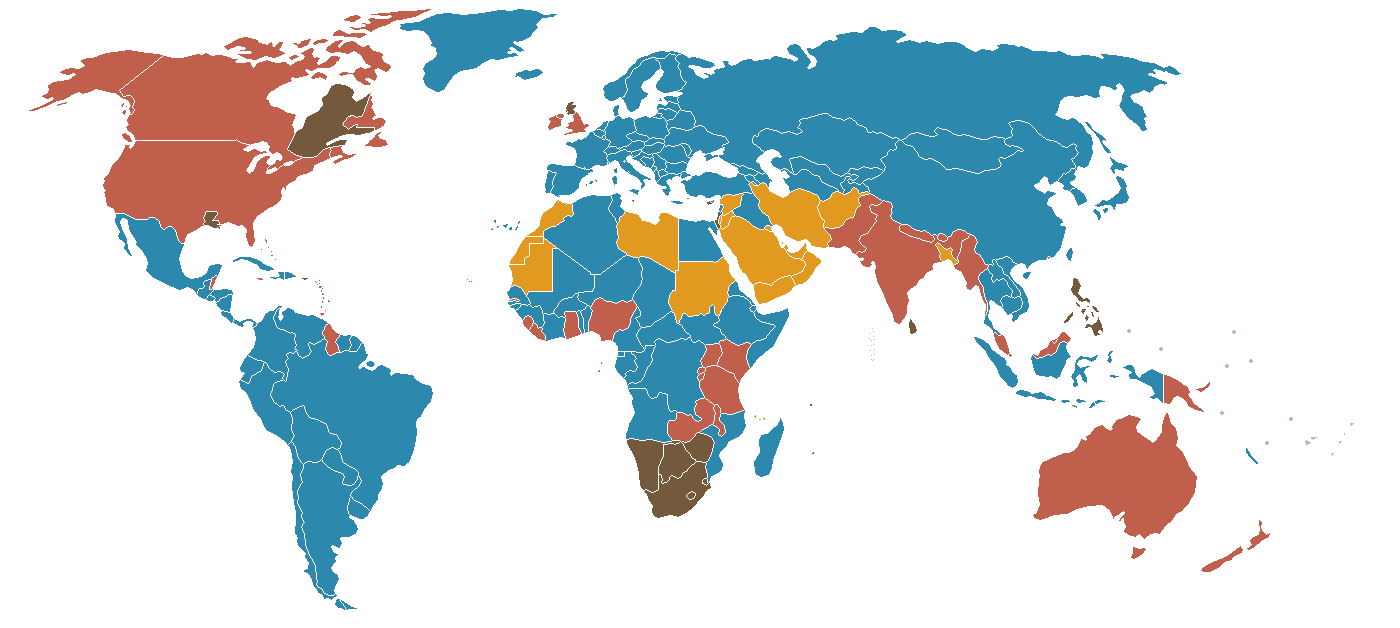
(Thanks wiki for such a well-researched diagram)
(click to enlarge)

I hope you have seen the movie 'Welcome to the jungle'. [If not, perhaps this trailer might help. See the part after 1.45 minutes]. It gives an amazing description of the rules that govern humans inhabiting the rain-forests. Not exactly, but yes, a fair description of tribal culture, where might is right and you got to have it in you, in order to survive. In early times, law used to be like that. It used to be governed by the ablest man's sword and whatever he said was the law. Thats the first legal system. Tribal laws. You might wonder whether it survives the scrutiny of modern times and advanced civilizations, but it still holds good. Be it Amazon's rain-forests or Andaman's tribal communities, these notions still continue. Perhaps an anthropologist might add more to that list.]

It is often said, common sense is not so common (so much so that I have even seen a book with that title, and ya, not read it). But such uncommon common sense is the common law. Confused? I will give you more reasons to be.

Ever met a reasonable man? Or a person whom you can call a perfect one ? [Hey, stop. I don't mean one perfect for a spouse] Perfect in the sense, one who would commit no mistakes, (not one who commits but is pardonable), one whose decision is perfect (not just for you but for all), one who knows everything and is wise, one who is strong but only to the extent an average man should be strong, one who is feeble but only to the extent an average man is feeble, one who is governed by human values but is not emotional, one who is smart but not smarter than an average man? Think you are really confused now by what I mean. But perhaps this is what I want.

I can quiet guess that your answer to the above is 'no'. Some might even to the extent of saying that there is no man on earth which fits the description. I quiet sympathize but sadly enough, there is one legal system on this planet which does not agree with you. It believes that such a man exists and exists in a big way. Such a big way that it is there at all times and at all places, one known as 'reasonable man'. This Mr. Reasonable has such a profound influence on this legal system that the entire system revolves around this Mr. Reasonable.

What would Mr. Reasonable do in this situation, what should have been the natural response of Mr. Reasonable, why should she/he not act like Mr. Reasonable in the situation? Does this sound familiar? Welcome to the 'common law system'. A system which believes the reasonable man is very common (and not so uncommon as per our understanding) and applies this test for all circumstances. All actions and inactions are judged from this reasonable man test to determine their compatibility with the law. This system is developed on the decision of the judges, which is known as 'common law'. The belief was that the judge had some divine connection with the Almighty that enabled him to lay down a rule (technically called 'precedent') which would be fit and apt for regulating human behaviour for all times to come, unless another divine logic comes to override the previous one. Now this has largely been taken over by legislature, which lays down the law and judge enunciates it. However, the judges continue to exercise this rule-laying down power and fill the gaps which the legislative law carries. Therefore, common law.

There is more to this though. The systems starts with law and then applies life-situations to it i.e. first comes the law and then whether the party to an incident acted in a manner consistent with the law laid down. This is the major reason which this system is stuffed with legal jargon, technical concepts (you already know one by now; the reasonable man, remember) and gives tremendous important and thrust to legal and logical reasoning (thought its really amazing that they do not collide most of the times) in solving life problems. [England, United States, India, Canada, Australia etc. are prominent countries following this common-law system.]

As opposed to this heavily-law biased system is another system where the factual aspects of the matter are more relevant rather than the technical enunciation of law; the 'civil law system'. It is easy to understand it as it is quiet the opposite of the civil law system. It starts with facts and then moulds the law to arrive at the correct decision. Here judge is not one wise man entrusted with a solemn duty to lay down a norm for social behaviour like in the common law system, but is in fact meant to resolve the dispute, termed as the 'inquisitorial' method of dispute resolution. The law here is a code, existing in advance and the judge is to resolve the dispute in accordance with the code. This is quiet distinct from the common law, where the judge generally adds to the existing body of law. [France, Germany, Denmark, Norway are some countries which follow this civil-law system]

Having read through the technical aspects and nuances of the these two major legal systems (I am sure you would be jittery and feeling heavy by now), I now take you to a simple and easily understood system. A legal system is dictated by religion and administered by religious priests. No wonder it is called 'Religious-law system' (though sometimes also termed as the 'Ecclesiastical System'. So what the religious texts, as interpreted by the clergy, say is the law that governs the people. Simple really, right? [Afghanistan, Iran, Saudi Arabia, Sudan are some countries which have adopted this legal system]

Then there remains just one more system to be understood; the 'customary system'. Though technically not a system in itself and just a principle of law (i.e. law develops from custom) it tends to be a system where habits and mannerisms of people force them to apply it as an obligation for all. This system is virtually a non-starter and not very prominent. Yet, wikipedia identifies atleast one country following this system.

Lastly, but not the least, don't be surprised to find a country the legal system which bears resemblance to more than one above. This is for the reason that countries keep experiencing and the judges tend to import concepts from other legal systems into their own. So we have various systems which reflect a culmination of the above principles. But in essence, they do tend to follow one system predominantly than the other.

Hope this was one interesting than the previous one (as I was told to do).

7 Dec 2007

Why LAW? (Law Series - 2)


Situation 1: Mr. Giant approaches Mr. Cute and says 'hey dumbo, I don't like your face!!! I am going to reshape.' Gives a punch and blow on the eye. Laughs and leaves. Mr. Cute is left ailing.

Situation 2: Miss Yojyna plans to goes for shopping at Oxford Street. She takes a cab from Regent Street and asks the driver to drop her at the nearest bus stop. The driver says 'Madam, why are you taking the cab. Oxford Street is just around the corner, just walk.' But she insists. So he says, 'alright. I am gonna take you to Oxford Street but you have to pay double the charge of whatever comes on the machine.' She responds, 'alright. so be it'. The driver drops her at the bus stop and asks for double the amount, as promised by her. She replies 'you cheat, you liar, you thug!!! you harressed me and tempted me to get in your car so that you could sell me to a sex-shop. help, people help !!!' The cab driver sees people accumulating and so runs off.

Do these situations make you think? Is there something unfair going on in here? Is everything ok? Are the people crazy? Or is it just an everyday affair? Happens just around the corner everyday, right?

I will try to explore the answers to these while dealing with the issue, why law?

Though the question 'why law' is not as perplexing a question as to 'what is law' but the answer to this is essentially embedded in the determination of that other question. Thus the most approximate answer to this 'why' is that law is needed to regulate human behaviour. But another 'why' leads to the question, 'why do we need to regulate human behaviour?' and it is here that we need to appreciate the nuances of a social structure, that also leads us towards discovering the answer to the question 'why law'.

Defining human behaviour is, essentially, a prediction as to interactions which take place when two humans interact; do they act friendly, do they turn hostile, do they act as unknown, etc. The reason is essentially the xenophobic and self-preserving tendencies of humans, coupled with the fear-factor and self-interest motivations, which influence interactions. Therefore, there arises a need for an independent unbiased person/institution to define the specific parameter in which the interactions should take place. These parameters acts as the rules of bounded rationality in which the interactions should take place.

The rules (or 'law') conceive general and specific situations which are to be promoted or avoided and accordingly devise mechanisms influencing these interactions. To illustrate, the rules prohibit interactions between parties where there is an inequality of bargaining power (therefore the concept of undue influence and other 'vires vitiating consent' in the law of contracts). Also, the law gives a legal protection to those entities which are considered to be ignorant of their self interests (like doli incapax and similarly the concept of statutory rape in relation to minors, etc.). It is here relevant to point out that these rules vary across countries and regions, depending upon the social ethos and morality issues operating therein. For example, while India prescribes laws against the harmful practices of Sati and child-marriage, there may not be any need for these laws in European jurisdictions wherein such practices are unknown.

As regards the side of promotional factors, one illustration can be the promotion of research and development, intellectual outputs etc.; therefore the protection and right of exclusive exploitation to the harbingers of intellectual property. Similarly, the law rewards good behaviour and so the concept of probation.

Therefore law comes to define the environment in which the interaction should take place; the manner in which interaction should take place; the grounds for and effects of abuse; prohibitions and debarring of erring individuals; rewards for good behaviour; etc. Thus law is required to govern; govern the governed (individual or subjects) and govern the governing (person or institution). Thus these set of rules act as the paramount basis for governance, and this is how the legal system works. And therefore we have LAW.

Now let us come back to our two situations. It may be right in a few places that Mr. Cute was punched. But a majority of people will say that this was wrong on the part of Mr. Giant and he must be punished for that. But why should he be punished. Did he do anything wrong? Not until it is recognized that the conduct of Mr. Giant was unacceptable in a social system and there is a punishment prescribed for that. Doing that, is precisely what law is for. It recognizes and defines what is impermissible social behaviour and proscribes mechanism to ensure that such incident is not repeated.

Similarly, in the second situation, while it was wrong on the part of the cab-driver to ask double payment, it was similarly wrong on the part of Miss Yogjna to shout at him in an offensive and rude manner. Now it depends upon the social perspective in which we are in, to decide what law should prescribe for it. Should the driver be held to have done an acceptable act (and thus there be a law to prohibit that) or the lady to have done something obnoxious (and thus dealt with accordingly) or should both of them be taken to task for what they did. I would leave you with that, to define in your own terms as to what should have been the next step that law would have taken after the incident took place, of if you desire, what should the law say for such situations.


** [ For general interest, I may as well point out that these rules are subjective, subjective to the one laying down these rules (and therefore they vary). This is for the reason that societies, invariably, identify a chosen one (or chosen few) to lay down these rules. The selection process of this chosen group may again be laid down by habits or prevalent practices. This chosen group remains responsible for laying down these rules in a manner, as it is so expected from it, which is in the best interests of those to whom these rules apply. For example, in early England the King was the 'fountain-head of justice', next to God and was considered the chosen one to lay down the law. Now the system that works is termed as the 'rule of law' i.e. no one is above the law, the law-maker himself.

Thus, while there may be a reason behind the legal rules, which may as well be clearly evident from the rule itself (like a rule prohibiting corruption / bribery etc.), there may not be an identifiable reason behind the rule (like why a particular age is declared as the age at which an individual attains majority). These are questions mostly left unanswered and justified as 'legislative wisdom'. ] **

6 Dec 2007

What is LAW? (Law Series - 1)

What is law? Good question actually. For it does not have one unequivocal answer. It fits in all these and other descriptions; it is a stream of thought, a literal depiction of bounded rationality, a societal instrument for regulating human behaviour, a means of social change, collective intelligence of a civilization, a code of best practices, etc. etc. etc.

The Dean of my Law University used to define law, for a lay-man, as 'codified common-sense'. I see no hiccups in accepting that definition but for the fact that it is just like a blind-men explaining an elephant. While the description is correct, it fails to exactitude the description of law covers all its contours.

Then there is another description that 'law is a system of rules'. I quiet agree with this statement except for the fact that certain dimensions of law do not exactly fit in this description. For example, major portions of international law are not rules but just sought-after practices, which may or may not be honoured. Nonetheless it is appropriate to go ahead with this understanding and explore the concepts further, given the fact that there would be exceptions to any definition.

Now once we have a system of rules, what does it do? what is it meant for? why have this system of rules? The answer to them seem to be historic as well as the outcome of human interactions with each other. A law-less world can be best described as a potion of Darwin's theory which relates to the 'survival of fittest'. Thus there would be a position of might is right. Thus to evolve a better social system (ofcourse the use of the term 'better' here is a relative term, depending on the needs of the majority of social cross-section the system is meant for) there are brought in 'rules' which regulate the ways in which human interactions takes place.

A lot of this is explained by the 'social contract theory' which builds it premises on a hypothesis that the people (in a 'state of nature' i.e. the social order prior to the legal system coming into place) agreed to limit their own rights and confer them on an individual/group of individuals/institution (depending on which version you chose i.e. of Hobbes, Locke or Rousseau) which they conceived as a better protector of their rights and liberties.

Thus the society accepted towards positioning itself in a system where the rules would flow either from top (in a 'Kingship' type or similar based system) or bottom (in a 'democracy' type or similar system) and everyone would be abide by them. Initially there was a system that even the rule-maker(/s) would abide by them except for certain special rules which applied to him(/them) specifically but with passage of them most of these rule-maker(/s) came to place themselves in a position where they only made the rules for others and were not required to abide by any. [Thus is explained the hue-and-cry for 'good-governance' norms to be applied to these rule-making institutions.]

But as things became, they stand as thus, there exists a rule-making institution, called the 'sovereign' (which may be a single individual) which is the originator of these rules, meant to be followed to whom they are addressed and these rules are collectively termed as 'Law'.

This simplistic understand of law, when exposed to the special needs and circumstances and the subject matter it regulates, assumes hybrid and diagrammatically-opposite dimensions and becomes quiet complex. However what remains the same is this underlying of regulating human behaviour. Thus becomes 'law' as an institution in itself, permeating all self and affecting all.

Law Series


As I had originally thought, having written a lot on random issues, I now move on to write on a series of legal issues.

Since I have noticed that it is often a complaint that law is drafted in a manner such technical and full of legal jargon that none other than the legal professionals are able to identify and understand the substance of enactments, which no doubt effect them day in an out. So I try to give my understanding of issues and ingredients in a non-technical language.

I have named these series of posts as 'Law Series' and as of now I have identified a few topics to deal upon. I will keep adding to this identified list and try to cover as many areas I can. As of now, this list stands as follows;
  1. What is LAW?
  2. Why LAW?
  3. Major legal systems of the world
  4. Branches of LAW
  5. Makers of LAW
  6. Administrators of LAW
  7. Trend-setters of LAW
  8. Executors of LAW
  9. Natural Sciences and LAW
  10. Social Sciences and LAW
    1. Economics
    2. Sociology
    3. Psychology
    4. Political Science
    5. History

11. Legal Professionals
12. Jurisprudence
13. Schools of Legal Thought


Let us see how far and deep I am able to go in this.

[ :) ]

4 Dec 2007

WTO at the cross-roads: Part - II


In the last post I wrote about the genesis of WTO and international trading regime. Here I essentially continue from where I left, raising issue and bringing to fore the controversies which have stalled the progressive liberalization of international trade, which has been the hallmark of this institution.


It starts with agriculture (which incidentally has also been the first objective of international trade) and ranges from services to Intellectual property et. al. The seeds to these were sown in the Uruguay Round itself. The Agreement on Agriculture was the outcome of a compromise. A comprise effectuated between the North and the South wherein concessions were given by both the sides in order to conceive an international institution promoting free and fair trade. While the North agreed to open up its (1) services sector (technically known as 'Market Access') and also did up with the licensing and quota policy on (2) textiles, the South compromised on (1) Intellectual property and (2) agriculture.

All WTO agreements on these four sectors, owing to the compromise, were incomplete and transitionally existent. They provided for a progressive liberalization, which would result into binding obligations for the WTO Members in a manner which was considered to be liberalization of international trade. It was agreed that the Members would generally and without being affected by prejudicing national interests (sic) think rationally and thus allow the free flow of international trade and thus permeate into effect the economic notion of competitive advantage, which predicted welfare for all.

However the fallout were different. The governments of these Member states, who committed to these agreements were already under immense criticism from their national rival political parties for having bound their country in the hands of an hitherto unknown institution. Further, the developing countries had a fair cry of immediate necessity whereunder they were required to act quick in order to provide for their citizens whereas such philanthropic gesture was not forthcoming with such promptness. Then there was the NGO factor, which cried foul the entire institution as an instrument in the hands of the developed few to extract what remained in the developing. The very first cases very these developing countries were dragged to the binding dispute settlement mechanism of the WTO coincided with such allegation of abuse and violation of trust. For example see; (1) India-Patents (2) Argentina-Patents (3) Pakistan-Pharmaceuticals (4) Brazil-Aircrafts, just to name a few.

This, inter alia, led to developing countries to unite and strive for the rights they were legitimately entitled to under the agreements but were denied. The developed countries continuously kept pressing for increase in market access in the developing countries (ever wondered why India and other countries are continuously raising the FDI limits in various sectors and that to at such a frequent pace?) (and also the raising standards for intellectual property rights) while they did not simultaneously dilute the barriers to agricultural imports from these developing countries, which incidentally was the only prominent tradeable commodity for them.

Intense international pressure led the WTO to dedicate the Doha round (for more please read the last post) to development. However this was never felt sufficient for the members representing the developing countries had been used to lip-service and wanted some significant works now. The EC cited its own internal problems (such as the 'Common Agricultural Policy' or CAP, and the development of the internal markets) while the US argued that the developing countries had still not done enough to expect concessions. Then there was the Cairns group, which was totally opposed to the developing countries getting a strong-hold in agricultural trade. Thus arose a complicated tussle, which no one was willing to find a solution for.

The Members kept postponing the deadlines, but could not arrive at any agreement, being unwilling to budge from their position and avoiding giving concessions. The issue thus lingered around. One who moved first and sought to break-the-ice, would have been considered the weaker link and would have been compelled to provide more concessions. Thus the negotiations were stalled.

Thus stands the WTO today, all being unsure of its fate. Whether the institution would survive the onslaught of time and developmental needs of more than half the world population remains to be a proposition requiring the test of time. However one thing is sure; WTO being the first international institution with a binding nature of obligations, it is quiet possible, with the stalling which it has faced, that future international commitments move back to the original position and keep the international law making more of a voluntary and optional type rather than conceiving a binding institution.

3 Dec 2007

Death penalty for rape: A right choice?


Well, this one is being written of someone's request. Lets hope I am able to put up my perspective for the issue.

To start with, both 'death penalty' and 'rape', in law, have been one of those issues which have received tremendous jurisprudential exposition. But the scholars have still not been able to come out with a set of agreed principles on each of these issues. So to clarify, it is not possible for me to summarize what these different schools of thought say (I know a lot of people would be expecting this, sorry to disappoint you guys) and I am here just to give what I think should be the issues to be taken into account for determining the stakes.

Firstly, the utility of death punishment has not been aptly justified. No doubt it is an extreme form of punishment but it is not always a deterrent. It is well known that in medieval England pick-picketing was sought to be deterred by making the offence punishable with public hanging and when there were the maximum instances of pick-pocketing recorded when such hangings used to take place. So the effect is not widely appreciated.

Secondly, rape is not only a crime against woman, it is also a crime against humanity which requires the issue to be looked against a policy perspective as well. Thus if the issue was purely a crime against women, the victimological approach may well have been applied and the accused be convicted with that level of punishment which would have indemnified the victim. But this does not strictly apply to a case of rape. The issue is more sensitive, owing to the cultural issues also involved here. Like take for example the Scandinavian countries where the question of morality-in-law and cohabitational issues are of not much vital significance and thus issues such as rape are not dealt with at all from a legal perspective. However in legal systems where law is derived from religion, the issue may be dealt with very seriously, even sometimes acting against the victim herself. So the treatment is basically dependent on the legal system's approach to the gravity of crime.

Thirdly, the questions of retribution and policy-considerations are also important. This takes into account the placing of the victim. Especially in India, where many a times the trend has been (of course with the consent of the victim) that the perpetrator of the crime has been required to marry and provide for the victim, thus making a societal leeway for the victim's maintenance and well being. The effectiveness of this mechanism is arguably debatable but I just wish to project this as an acceptable social fact.

Finally, which I think is the most important reason not to give death penalty to a rape accused is I think a practical one. If the perpetrator of the offence knows that the punishment for rape is death penalty (which ofcourse he would know), then he might as well consider to kill the victim after having committed rape for the punishment for death would be the same. Thus the perpetrator would become indifferent to committing rape or death, a dangerous proposition indeed as it would lead to more victims of rape being killed as opposed to mere rape where atleast (given the anonymity given to them under law) they can survive and have chances to start a new life.

Further, given the fact that human life is more valuable, no legal system would be designed towards making perpetrator indifferent to rape and death. It is also to be considered that if death is in fact made a punishment to rape, the perpetrator would, more often than not, try to kill the victim and seek to destroy the evidence and thus try to avoid punishment. However in a case where rape is punished with lesser punishment than death, there is reason enough for the perpetrator to leave the victim alive and seek shelter elsewhere.

There may be many more practical or jurisprudential issues relating to the issue at hand but I personally feel, for the reasons herein stated, that the answer to the issue at hand is no, and a big one.

WTO at the cross-roads: Part - I


2007: what a year!!! marks 60 years of the General Agreement on Tariffs and Trade, (or GATT) a landmark international agreement, with no predecessor and leading to an institution of its own. I thought what better to describe the landscape of international trading regime on this occasion. No doubt wikipedia had a huge content list on this topic and an awful lot of scholarly and political writing has gone into being behind it, but the fact remains that this arena has witnessed much that any description of it would in all terms be subjective and cannot remain apolitical. So here I go, giving my account of WTO. Starting from the start, coming of the present and the future in store.

The history of international trade can be traced back to the start of human civilization itself. Not that there were nations at that time but the first civilizations were generally settled across river beds and kept shifting. As times passed, they began to settle at a place and as they grew, came the principle of division of labour and specialization. And then the trade started; across cultures, across people, across places. The medieval era was marked by fixed international trading routes and the history of Constantinople tells it all.

But in the modern times, the prominence of the event is marked by the Great Depression, that followed the First World War. Facing economic crisis, trading nations being to impose heightened tariffs (or 'Customs duties') on goods coming into their territorial borders from other countries. The United States, infamously, levied duty to the tune of even 1000 percent on some goods. What followed was an international tug-o-war between nations, competing each other on imposing higher tariffs.

This led to wishful thinking of a rule-based regime in international trading systems. The problem was sought to be addressed at the Bretton Woods Conference, which led to the culmination of three international institutions; International Monetary Fund (IMF), International Bank for Reconstruction and Development (or World Bank); and the International Trade Organization (ITO). While the IMF and the World Bank survived the political onslaught and fierce criticism of the third-world countries, the ITO died a political death. President Henry Truman of the United States did not keep his commitments at the Conference and did not submit the ITO Charter (also called the 'Havana Charter') for ratification before the US Congress. Thus ITO could never materialize.

But what survived for the interim measure; the GATT. It was considered to be a stop-gap arrangement for meeting impelling necessities till the time ITO became operational. But since ITO could not come into being, GATT provided the international players an arena to experimental playground to bring out rules for a free-trade regime. And the outcome was various negotiating rounds, with the last one being in Uruguay in 1986, which lasted till 1994. As a result of this eight year intense negotiations was the WTO, as we know today, providing an unprecedented binding regime of commitments in international scenario. There was a huge hue-and-cry of loss of sovereignty by the national governments by accessing to the WTO but this new-yet-old institution survived the political onslaught for the time being.

However the troubles were far from being over. While the second Ministerial Conference went on to promulgate new rules for international trade, the third one in Seattle was a disaster. A huge clout of NGOs continuously interrupted the Conference and did not allow the Ministers to transact much in terms of political making. This led to giving these NGOs as a observer-status in WTO, a move which the policy makers will regret for ever, but was a necessary-evil at that point of time.

The huge scouting by these NGOs and the formation of various developing countries blocks forced the next Ministerial (at Doha) to rewrite the entire agenda as a development-based one. Initiated in 2001, it was planned to be over by 2003 (i.e. by Cancun Ministerial) but issued spilled over. Things could not be packed even by 2005 (i.e. till the Hong Kong Ministerial), despite an in-principle agreement being reached in August 2004.

And here we stand, in 2007, with the institution facing a crisis and dilemma as to the future course of action. The EC has its own internal issues to tackle and thus has never been able to contribute much for the growth of international trading. The United States is fascinated with its own internal revenue collections and thus carries a short-sighted agenda for the international trading community. The majority of agriculture based developed countries (called the 'Cairns group') is busy stock-taking its own policies. The developing countries (now 'G110'), led by India and Brazil, form an alliance of their own and are pursuing vigorously for their own interests. The WTO Secretariat, led to Pascal Lamy is wondering how to set the agenda, being crunched into the issues of agriculture and services, stands baffled.

What is at stake is not only the institution but national faiths in an international trading regime. I cannot predict the outcome of this tussle between the north and the south but one thing is for sure; the solution does not seem imminent.

Need for a full-fledged sports law in India


Cricket, a semi-religion of India; Football, the pride of Bengal; Hockey, legendary and high-esteem links with the game; Tennis, growing sensation; Golf, here to stay; ... With a population of more than 1 billion, sports in India have come to hold a prominent position not as a part-and-parcel of entertainment industry alone but as a professional league of its own. Gone are the days when sporting leagues were dominated by part-timers who had the resources to indulge themselves in the not-so-respectable-by-itself sporting arenas. Today are the times when sporting activities are a profession in themselves, requiring constantly being informed and updated of the changing times, involvement of technology and carrying with it all facets and dimensions which any other self-governing profession requires.


I am a firm believer of the fact that law most-often-than-not is remedial, following society and bringing into force regulation to influence the human interactions. To employ this for asserting the need for a sports law is not counter-productive.

It has been two years since the Supreme Court declared that BCCI was not a public body (technically 'State' within the meaning of Article 12 of the Constitution). The result; its actions could not be challenged on the grounds of public interest or otherwise. But does this dissuade the fact that this BCCI not only tinkers but controls what is the heart of public interest in India; cricket??? In fact, this has been declared by this Hon'ble Supreme Court itself that cricket is a matter of public interest in India, when it allowed the government to infringe the rights of Ten Sports for broadcasting cricket matches in India and otherwise. (The debate that public-policy-issues should not be allowed to interfere in purely private law matters, as invoked by this decision, is a separate one and I would deal with it elsewhere).

The thrust of the matter is that sports in India lack a principle based regulation and the control of sporting interests in India is spread across public-private associations of random diaspora. The Central Government does boast of a 'Ministry of Youth and Sports Affairs', but the lack of lucrative portfolio has led the Ministry to allow itself to be confined as an award-granting institution, cut-off from the ground-realties and unconcerned with the proper-planning, development and professional regulation of sports in India.

It has a National Sports Policy (last updated in 2001) but there is little empirical evidence as to how far it has translated into practice. No doubt it has been giving a lot of financial assistance to the professional bodies for the development of sports but I believe it is not sufficient. I think a lot needs to be done to organize the games on a more professional basis.

Initially, I had also thought of the option of a national sporting academy/institution to regulate all sports in India but carrying the doubts of whether it would be able to survive the aftermaths of bureaucracy and red-tapeism, I dropped that idea. I find that it is better to having a national sporting regulation to govern, finance, nurture and organise the sporting leagues in India. These leagues may be self-sustaining or state sponsored [like the case with most sports associations in India today] but would in any case be regulated under a central law, which would require financial assistance and autonomy to players, thus allowing them to fully concentrate on sports as a professional rather than an investment without returns.

The questions of how I leave again to the vagaries of political-will but the need for an immediate stock-taking of professional-sports regulation is imminent and requires consolidated and long-term game plans, if India has to succeed in promoting itself as a strong world-games-champs country.

30 Nov 2007

India: Another anti-terrorism law?


Terrorism, the growing menace in India and internationally, has evoked serious countenances. After all, desperate times call for desperate measures. Since executive branches have to take permission of the legislative branches and have to act within the authorized perimeter of permitted activity (defined by law), growing instances of terrorism have led to increasing under-currents in the developmental and institutive processes functional in the legal designs and frameworks worldwide. Internationally when we already have the various war crimes tribunals (such as International Criminal Tribunal for the Former Yugoslavia, International Criminal Tribunal for Rwanda, etc.), still the world-felt need for improved mechanism for international crimes led to the institutionalization of the International Criminal Court. Though there have been issued about its legitimacy, jurisdiction, infringement on state sovereignty etc., yet the ICC is here to stay and has commenced its work.

Nationally, as well, there have been wide-spread developments. For example, UK enacted a series of Parliamentary laws to deal with the issue; namely the Terrorism Act, 2000; Anti-Terrorism, Crime and Security Act, 2001;Prevention of Terrorism Act, 2005; Terrorism Act, 2006; etc., to deal with the grappling issue. Similar was the situation in the United States, a series of laws, with the most prominent amongst them being the USA PATRIOT Act, 2001 (i.e. Uniting and Strengthening America by Providing Appropriate Tools Required to Intercept and Obstruct Terrorism Act, 2001).

As for India, the
thing is not new. We have had seriously-civil-rights-prejudicing sedition laws for long, thanks to the colonial law. The hay days of Indian democracy have seen them implemented frequently, with the last most prominent invocation of them being in and around the 1975 national emergency. But we do have specialized terrorism laws as well. The first probably (though not technically) can be recalled as the infamous 'Maintenance of Internal Security Act, 1973' which was hugely invoked during the emergency period a couple of years later. The hype of the law was such that Lalu Prasad Yadav named one of his daughter as Misa Bharti (after the 'MISA Act').

This MISA Act was followed by more infamous Terrorism and Disruptive Activities (Prevention) Act, 1985 (or simply TADA), which was in fact the first specialized and
focused Indian legislation on terrorism. It was invoked heaving and indiscriminately against the Khalistan movement and during the 1990s Bombay blasts.

Thereafter we had a refined version of terrorism law, with a bit more rights to the accused, but an anti-terrorism law anyways: The Prevention of Terrorism Act, 2002 or POTA. The use of this enactment was not very prominent was still had a huge impact on the working psyche of the Indian police and armed forces, which employed the usage of this law to such a great extent that there was huge political furore over its misuse and thus leading to its repeal.

So, as of today, India does not a specialized anti-terrorism law. Any aftermaths? I do not think so. But still the Indian Parliament would like to have another stint with framing one. Good news or bad, that time will tell, depending upon the manner it is invoked and the use it is put to, but definitely, not a good precedent. Why do not we decide in principle to either have one or not to have one. Why do we keep on fondling with successive governments coming out with their own versions of such a law. It might even be better not to have one; there are sufficient powers vested under our ordinary criminal laws on the executive to deal with such situations.

The major advantages which an anti-terrorism law has on the ordinary criminal law of the land can be viewed as; giving more powers to executive to deal with situations; greater ability to armed forces to counter-act, with generally civil rights being suspended; higher conviction rates of the accused with less requirements of evidence and intent to be shown; etc.

But in any case, where would be head to with such a law and why? What are the major motivations for the government to go for a law which subverts and in some cases even over-rides the judicial process? I personally and frankly believe it is influenced by their distrust on the ability of the judicial process and the carving for more power.

If its the former, i.e. lack of trust on the judicial system, then why have one at all? Is it there for formality, to show the world that we have a civilized system with a committed judiciary and a developed jurisprudence but internally we find that its not worth it so we have special mechanisms in place to over-ride them at time and do what we think is the correct sense of justice such that it even does not require a trial.

If its the latter, it does not require any elaboration but is in fact an illustration of the human personality and diaspora; greed for power.

In any case, its not worthwhile to have one such law. It leads no where except for killing millions of innocent civilians, who are scarified in the name of preserving national integrity and well-being. And then there always are fall-outs from having a biased law, not to mention the irreparable harm it causes to the growth of judicial tolerability and legal certainly. Any body remembers the Habeas Corpus case in India, and the Regina v. R case in UK?

21 Nov 2007

Justice delayed is justice denied?


1997: The turbulent year with Indian politics dwindling to find a leader. No one sure of where the political system would lead to...
And then we have June 13, 1997; a warm Friday with flurry of activities going on, in anticipation of a week-end. South Delhi, as usual buzzing with the crowd making way from AIIMS to Hauz Khas and people enjoying the 1971 at the Indo-Pak border in "Border", the highly sensitive movie which really struck a cord in the heart of every Indian. And then we have a fire, a huge one, engulfing the entire "Uphaar". Much has been said about it since, so much so that even wikipedia has an entry on that. But I want to mean something from it.
It has been more than a decade now. But the legal battle between the survivors of the victims and those at fault for the incident still lingers on. It has already seen two rounds of litigation with the case being presently decided on by the Additional Sessions Judge in Delhi.
The facts are not really of essence here. The essence is that the credibility of the system is at stake. But then one is reminded of the deadly gas-tragedy which took place in 1984 in Bhopal by the leaking of methyl isocynide (every law student knows that) from the plant of Union Carbide India. And what was tragic that the Government of India, submitted an affidavit (i.e. swearing on oath on behalf of the entire country) before a District Court of New York (from where Union Carbide hailed) that the Indian legal system was not competent enough to deal with the issue. [I am not really sure as to how many know that but that really happened.] And that Court ruthlessly disagreed with what the Government of India said on oath and threw out the case from its docket, stating that it would not take into account a matter which did not take place within its jurisdiction. Legally correct, but hurting the self pride of all Indians !!!
But that is not essentially I am taking to emphasize upon. The thrust is that the victims of the tragedy have not yet been compensated after more than two decades of a settlement having reached and Union Carbide paid the Indian government for its alleged acts of negligence and mass torts.

Justice looks grim in this system. You can commit a crime and then be swayed away from the clutches of the legal system for decades [for example the decision of the Bombay blasts of 1994 having come out in 2007 with the procedure of appeals, revisions, reviews etc. still to have their role in the procedure] till finally a day would come, when the witnesses would have vanished [any one remembers Satyendra Dubey, a government engineer who exposed corruption in the national highway building program and then was killed mysteriously???], the victims and their survivors paid, intruded or persecuted [to remind oneself of the various stages the Jessica Lal murder trial has witnessed] and no one really interested, except the press ofcourse, of the outcome of the case.

The Supreme Court itself has more than 45,000 cases pending before it. What to speak of High Courts and then the trial courts and tribunals etc. There is no point really guessing when the outcome of a case would be out. It could be years, decades, or even more. I am a lawyer myself and in this short stint that I have laid my hands of briefs, I have already handled many which were filed even before I was born. Can't help the poor litigants really. You feel for them for some time and then you gradually take it on as a hard reality of the system and take that for granted.

Lot has been said over the pendency of judicial appointments and the looming vacancies in the judicial system we carry, but that is no comfort to the litigant. Someone has to and something has to be really done, before 'justice delayed is justice denied' may become the norm than the exception that it really is...

19 Nov 2007

Indians are the highest tax payers in Asia ???


I came across this article today which claimed that Indians are the highest tax payers in Asia. However what it did was to just compare the tax rates of the salaried class, compared with jurisdictions like UAE (which by itself is a tax haven, given the low tax rates there), Russia, Hong Kong, Taiwan, Singapore, etc.

It provoked in my to find out the reasons why...?

Just because of the fact that the personal income tax
rates in India are on the higher side, does that mean that we automatically become the highest tax payers? Like what happens to those tax planning measures that we get under the Act itself? What about the reduction in rates you get when you translate you income into [long term] capital gains? And finally, is the salaried class all that comprises India? What happens to the business income (which covers a substantial number of people given the fact that so medium and small-scale business enterprises are spread across the country), income from house property (covering those who make their living on the rent they get from the property they lease out), income from other sources etc., which comprise of a huge share of income and have deductions and tax-incentives inbuilt in them?

I think the proper way to find out the tax payers would have been to compare the 'Per-Capita Tax Collected' rather than just drawing conclusions from the basis of differences in tax rates.

For example, Pakistan imposes the similar rate of taxes on individuals' and corporations' incomes. Are both the highest tax payers in Asia. No. The answer is not that simple. For analyzing this, one needs to take into account the level of contribution individual tax-payers have in the national tax collection figures. What is the per capita payment of tax in the country and how is it really reflective of who actually fills in the national income tax coffers? i.e. is it the companies, individuals or foreign investors who bear the brunt of taxes???

Thus it seems that a mere reliance on the rates of tax to conclude as to who pays the highest tax would be absurd as that conclusion would be based in ignorance of the actual ground realties [ever heard of Section 80 and 80G and 80L etc. and the series of exemptions provided there ???] and the actual tax collection figures...